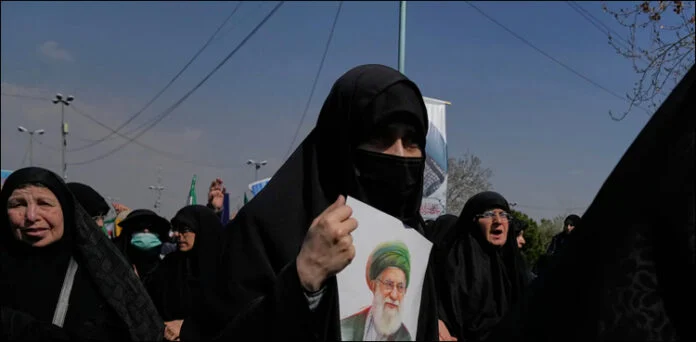
Washington, March 8, 2026 — A new intelligence assessment prepared by U.S. agencies suggests that even large-scale military attacks on Iran are unlikely to result in a change of government in the country. The report raises questions about the effectiveness of strategies aimed at removing Iran’s leadership.
According to the The Washington Post, the analysis was prepared by multiple U.S. intelligence agencies and concludes that Iran’s fragmented opposition would struggle to take control of the country, even if the current leadership were removed.
Intelligence Agencies’ Assessment
The assessment reflects the collective analysis of 18 U.S. intelligence agencies. The findings were reportedly compiled by the National Intelligence Council, a body made up of experienced analysts who produce confidential reports on global political and security developments.
According to the report, Iran’s political and military system is structured in a way that allows it to continue functioning even if key leaders are removed. Analysts believe the country’s institutional structure could maintain stability despite major disruptions.
Questions About Proposed Strategy
The findings have drawn attention because they appear to challenge earlier statements by Donald Trump, who previously spoke about the possibility of removing Iran’s leadership structure and installing a different governing authority.
The intelligence report was reportedly completed about a week before hostilities between the United States and Israel against Iran began on February 28.
However, it remains unclear whether the White House briefed the president about the full contents of this intelligence assessment before approving military action.
Scenario if Iran’s Supreme Leader Is Removed
Intelligence analysts also examined the potential consequences if Iran’s Supreme Leader, Ali Khamenei, were assassinated or removed from power.
According to individuals familiar with the report, intelligence agencies concluded that Iran’s religious and military establishment would likely activate pre-existing succession mechanisms designed to maintain continuity in governance. This means the system could continue operating even in the absence of its current leader.
Weak Prospects for Opposition Control
Another key conclusion of the report is that Iran’s opposition groups are currently too divided to effectively govern the country.
Analysts described the likelihood of opposition groups quickly taking control as “weak.” The report emphasizes that the opposition remains fragmented both politically and organizationally, making it difficult for them to establish a unified leadership structure.
Expanding Military Operations
Meanwhile, military operations involving Iran have reportedly expanded geographically. Reports indicate that naval tensions have increased toward the east, including submarine activity in the Indian Ocean.
To the west, missile-related confrontations have also been reported near Turkey, a member of NATO.
These developments suggest that the conflict is spreading beyond its initial areas of engagement.
White House Statement
In response to questions about the operation, White House spokesperson Anna Kelly stated that the administration’s objectives remain clear.
According to her statement, the goals of Operation Epic Fury include:
-
Destroying Iran’s ballistic missile capabilities
-
Targeting Iran’s missile production capacity
-
Weakening the country’s naval forces
-
Preventing Iran from supplying weapons to allied groups
-
Stopping Iran from ever obtaining nuclear weapons
She added that the Iranian government is currently facing significant military pressure.
Previous Reporting on Intelligence Concerns
Concerns within U.S. intelligence circles about the difficulty of achieving regime change in Iran have been reported before. Major international outlets such as The New York Times, Reuters, and The Wall Street Journal previously mentioned doubts about whether opposition groups could take power.
However, the involvement of the National Intelligence Council and its detailed analysis of both large-scale and limited military strike scenarios had not been widely reported until now.
Expert Opinion
Suzanne Maloney, vice president at the Brookings Institution and an expert on Iran, said the intelligence assessment reflects a deep understanding of Iran’s political structure.
According to Maloney, the prediction that Iran’s institutions would remain intact is based on long-standing knowledge of the country’s governance system and the mechanisms that help maintain continuity within the Islamic Republic.
Conclusion
The intelligence assessment highlights the complexity of political change in Iran. Even under severe military pressure, analysts believe the country’s existing institutions may continue to function.